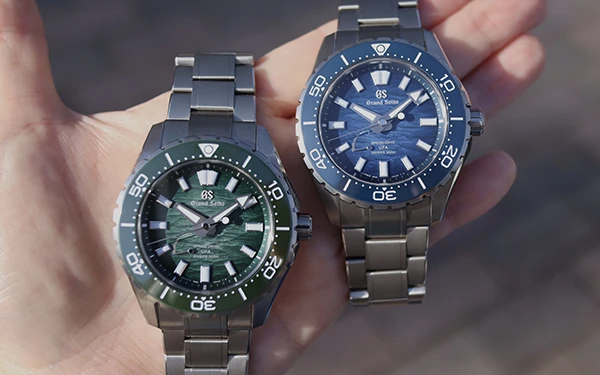
At Watches & Wonders Geneva 2026, the Evolution 9 Collection Spring Drive U.F.A. Diver Ushio 300 was unveiled as the smallest diver’s watch in Grand Seiko’s history. For those looking for a lightweight diver’s watch with a narrow diameter that doesn’t feel thick, this model is one of the perfect choices. The lineup consists of two models, with dial colors commonly known as “Ushio Blue” and “Ushio Green.” Both have a theme of the “sea,” but you can see different expressions. This time, we will take a deep dive into the ocean’s expression and colors projected onto the dials of these two models, along with recommended coordination ideas.
Mutsuyo Ito: Text & Photography
Photographs & Text by Mutsuyo Ito
[Article published June xx, 2026]
SLGB023, what is the SLGB025 “Ushio 300 Diver”?
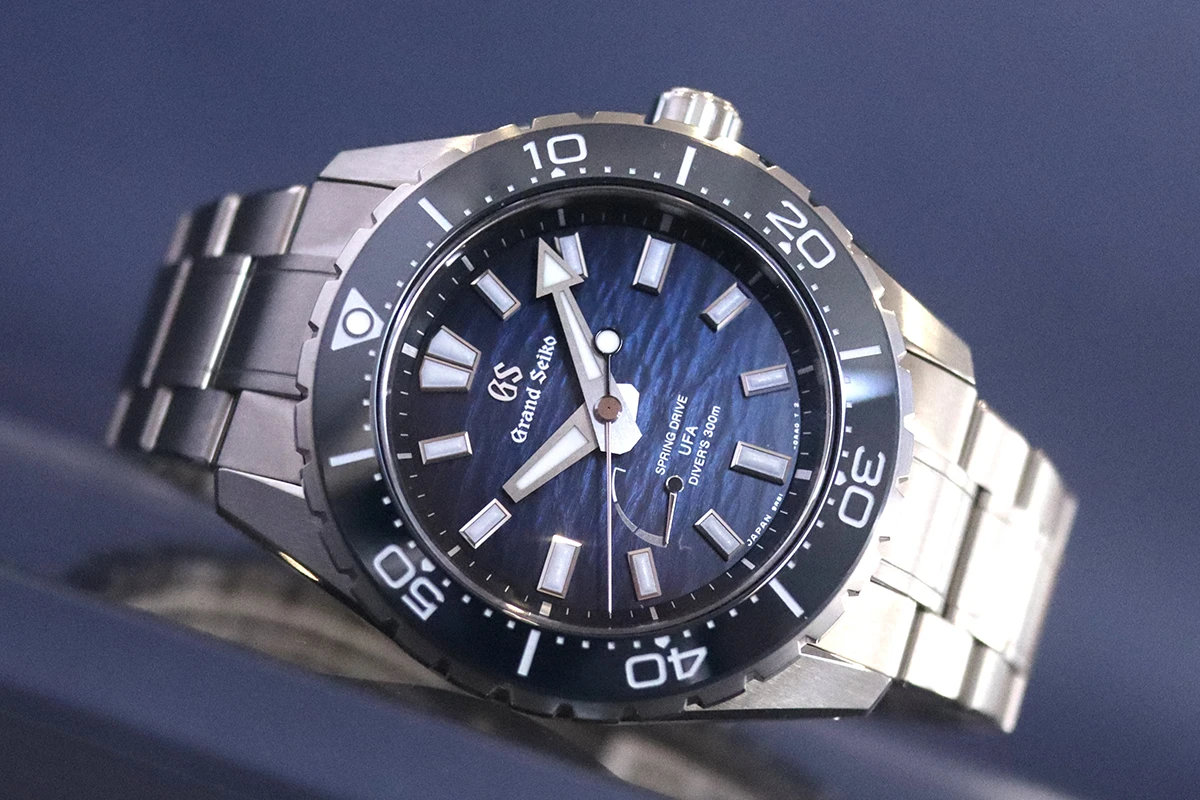
Grand Seiko ‘Evolution 9 Collection Spring Drive U.F.A. Ushio 300 Diver SLGB023’
Automatic spring drive (Cal. 9RB1). 33 shi. Power reserve approximately 72 hours. Bright titanium case (diameter 40.8mm, thickness 12.9mm). 300m water resistance. 1,650,000 yen (tax included)
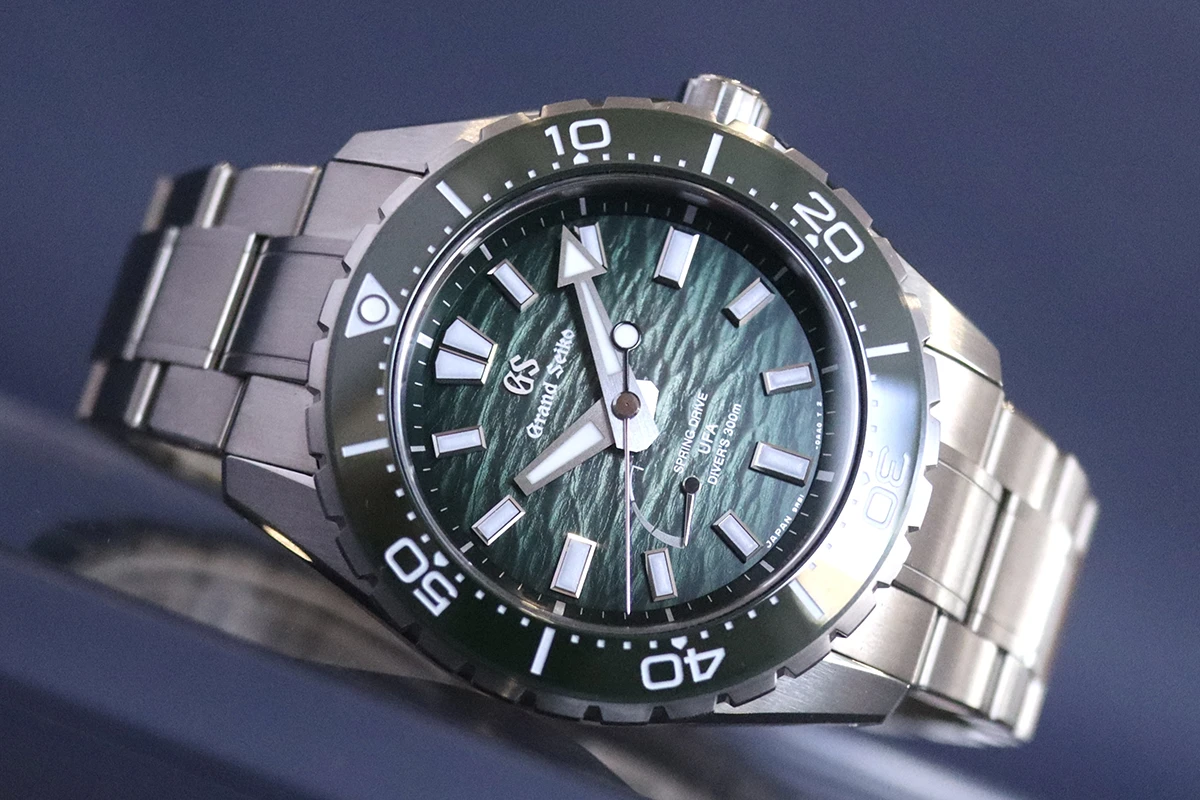
Grand Seiko ‘Evolution 9 Collection Spring Drive U.F.A. Ushio 300 Diver SLGB025’
Automatic spring drive (Cal. 9RB1). 33 shi. Power reserve approximately 72 hours. Bright titanium case (diameter 40.8mm, thickness 12.9mm). 300m water resistance. 1,650,000 yen (tax included).
At Watches & Wonders Geneva 2026, the “Evolution 9 Collection Spring Drive U.F.A. Diver Ushio 300” is the smallest diameter ever made for Grand Seiko diver’s watches, which drew attention at Geneva 2026. The Spring Drive U.F.A., announced last year, boasts an ultra-high precision of ± 20 seconds per year. It is equipped with the new Cal.9RB1 movement, known as (=Ultra Fine Accuracy).
There are three differences between the previously released Cal.9RB2 and this model. There is a calendar, the position of the power reserve display, and the shock-resistant shape of the rotating weight. The most obvious difference was probably the removal of the calendar display. This resulted in a sleeker design. Additionally, by reducing the overall number of parts, it was possible to achieve a slimmer profile while incorporating essential elements for a diver’s watch (= water resistance and securing a rotating bezel).
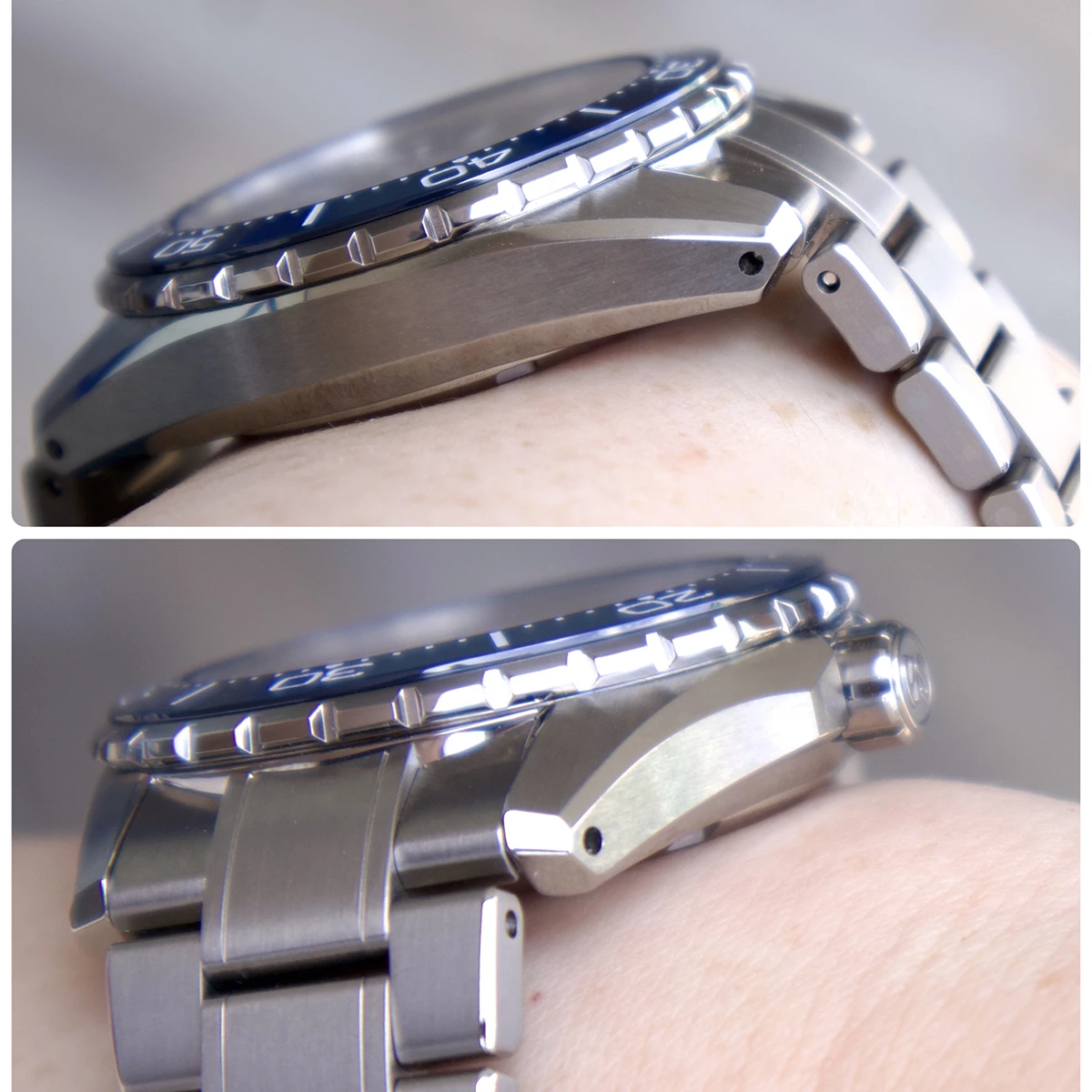
The thickness is 12.9mm. Combined with the small diameter (40.8mm diameter), it blended well even on my rounded arm (15cm circumference).
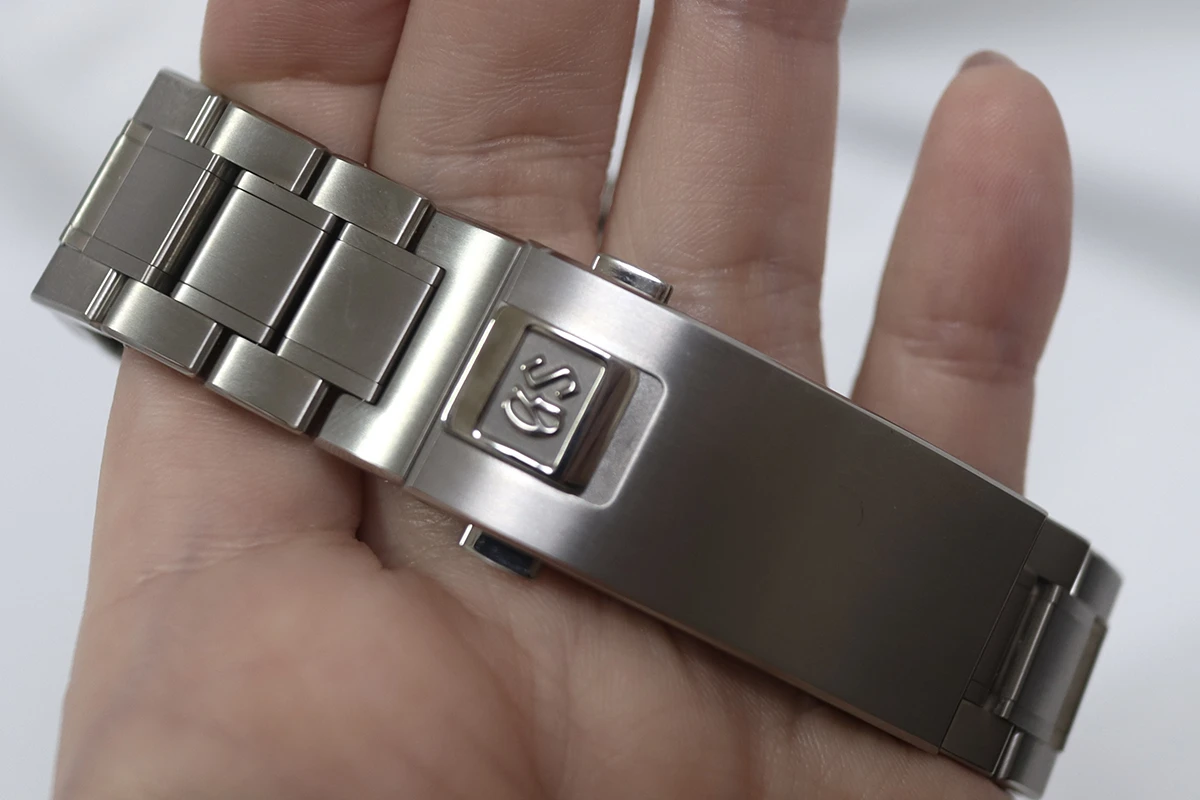
And don’t forget the specifications of the Nakadome. The nakame uses Grand Seiko’s first buckle with a slide lock extender system with fine adjustment mechanism. Long name…… I wonder if I’m the only one who felt that way. In other words, this buckle features a 3-step adjustment mechanism × 2mm and a 18mm slide-lock extender for diving, allowing for a maximum extension of 24mm.
Additionally, the buckle logo features a double lock function. Personally, I like watches. However, in reality, I haven’t had much contact with diver’s watches. Therefore, I was honestly surprised by this Nayu mechanism.
If you ask me what it is, it’s a bit embarrassing…… It took me about 20 minutes to find the extender function. When I found it, I was so moved, thinking, “Wow, this is amazing!” and probably something dopamine was pumping up in my mind. I only noticed there was an explanation video on the official website after filming was finished. So, I would like you to share the information you found on your own during these 20 minutes (see image below).
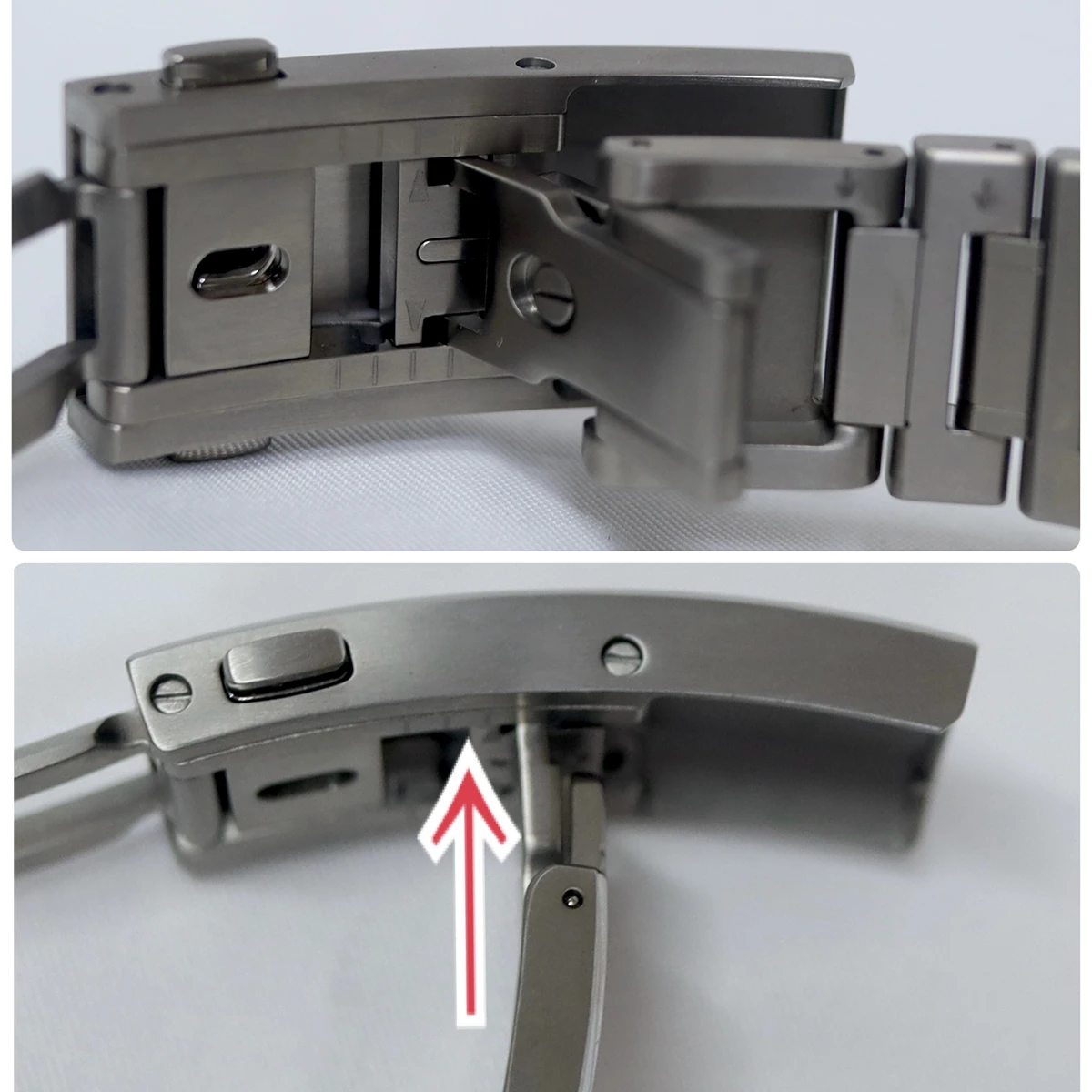
(Top) Photographed Nakadome from the inside. A diagram showing the outermost of the three fine-tuning mechanisms. The extender section extends forward from the center of Nakadome. (Bottom) Side photo of Nakadome. By pushing and moving left and right in the direction of the arrow, you can make fine adjustments.
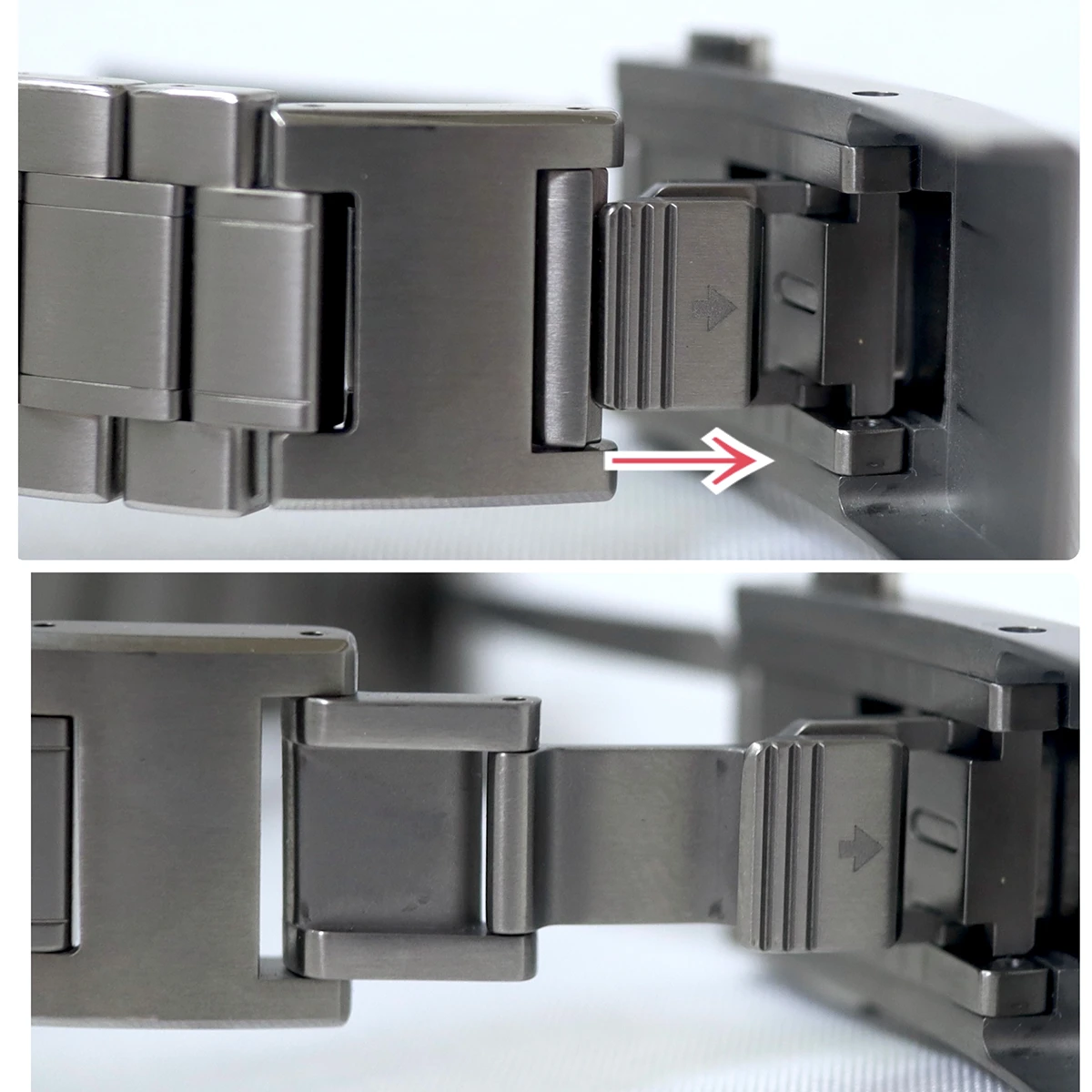
Slide lock extender section. By sliding a small plate marked with an arrow in the direction of the arrow, the folded part opens up as shown in the image below, allowing you to extend its size.
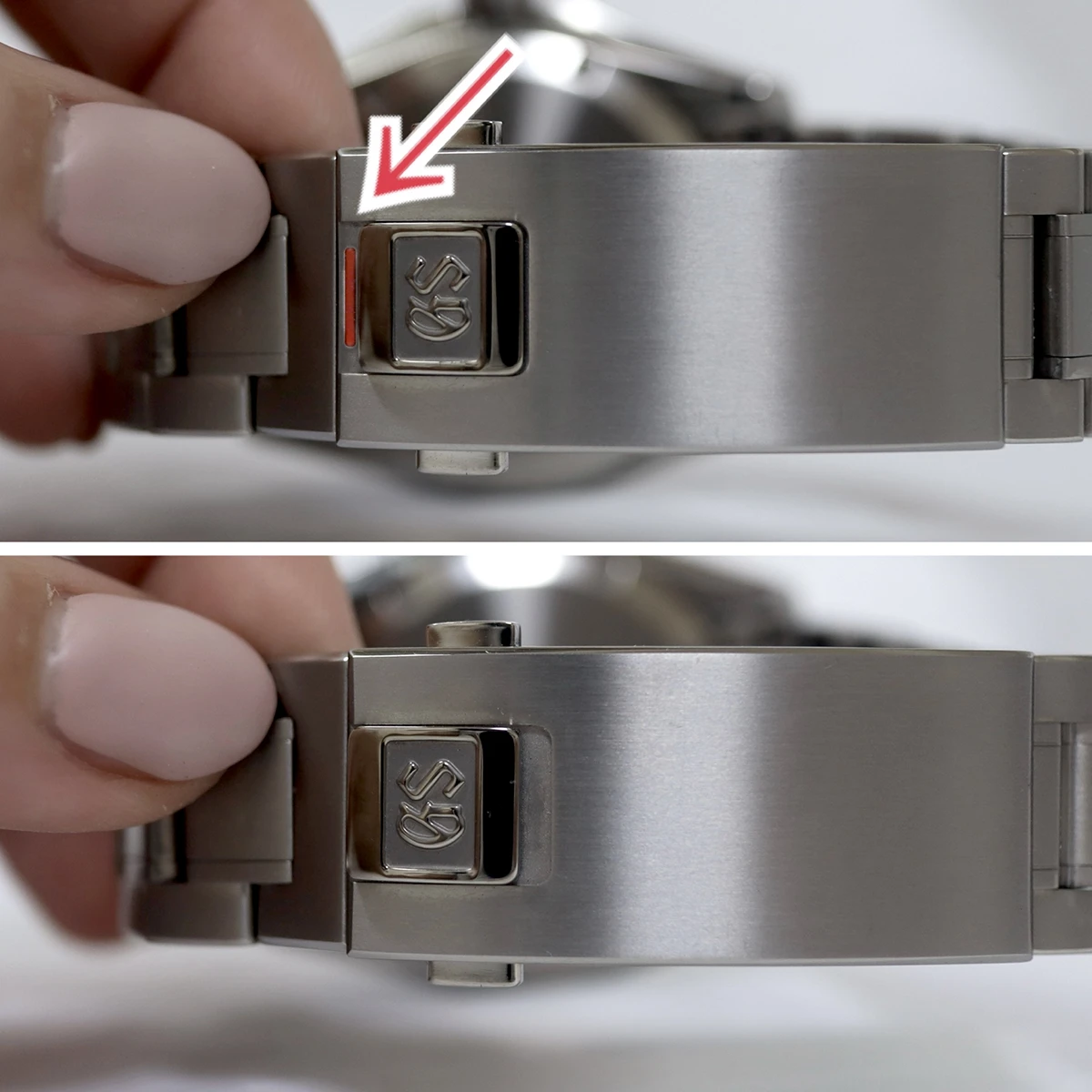
Nakadome with a double lock function. You can lock the GS plate by sliding it. When red is visible, it means the lock is not engaged.
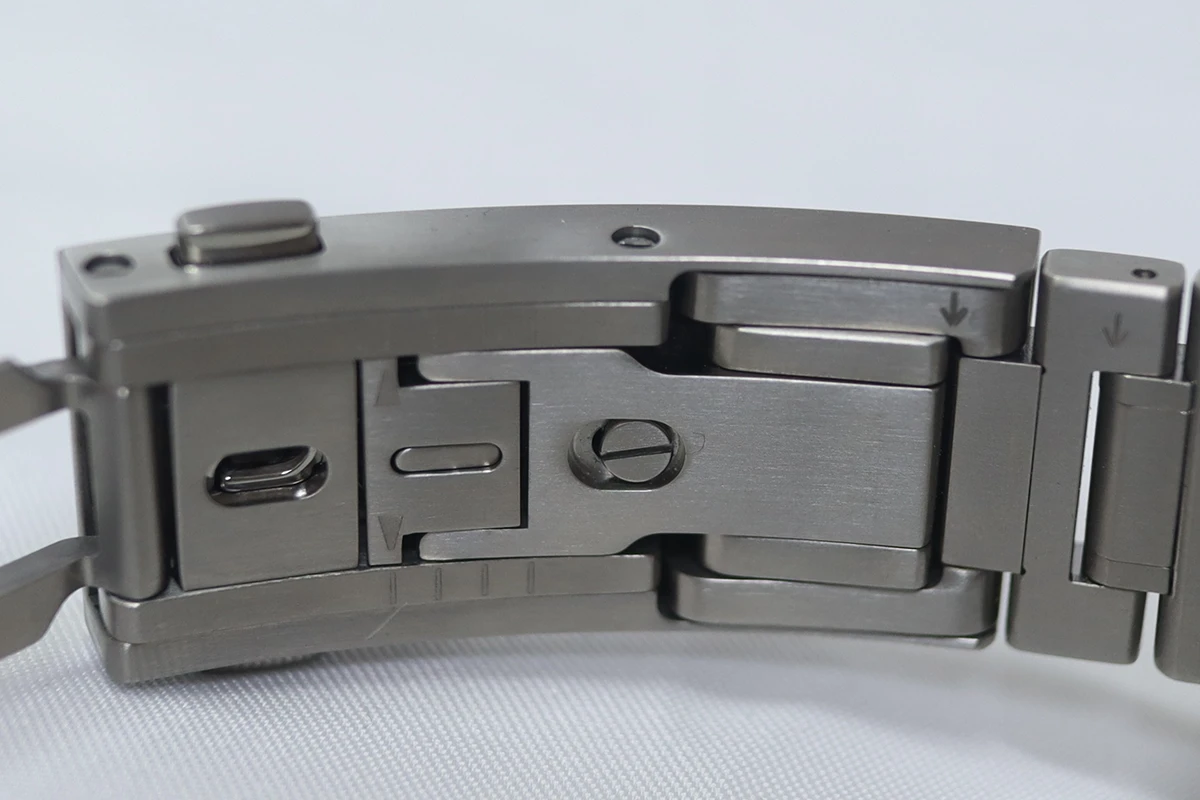
All functions are left in a state where they are stored.
The dial lineup comes in two colors: “Ushio Blue” and “Ushio Green.” The nickname “Ushio” comes from the tidal current “Ushio” that nurtured Japan’s abundant marine resources as an island nation, and both models feature a molded pattern on the dial.
The SLGB025 is colored by Epson’s specialty optical multilayer coating, and the SLGB023 is plated and lacquered. This color represents the vast sea surrounding the Japanese archipelago.
Explaining the colors of the “Ushio 300 Diver”
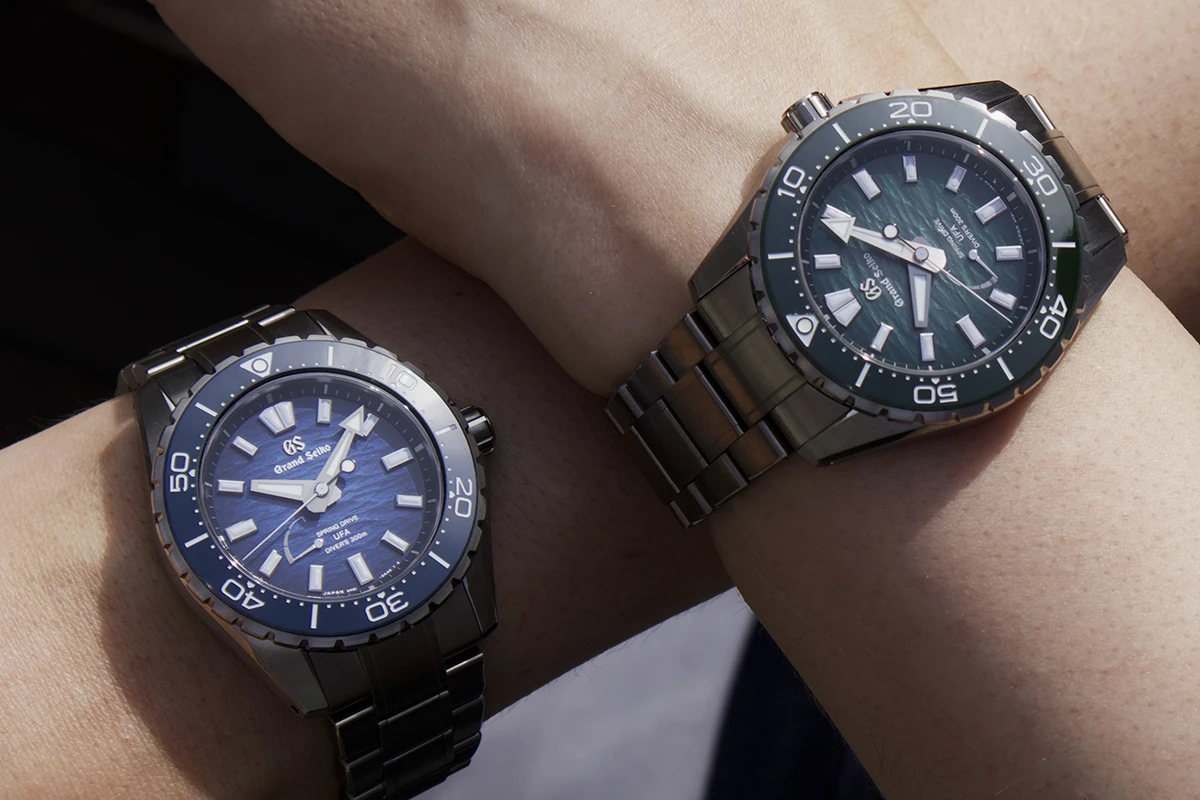
Both SLGB023 and 025 use bright titanium for their cases and bracelets. When people think of Bright Titanium, they tend to focus on its lightness and corrosion resistance, but its color is also distinctive. Compared to stainless steel, it has lower brightness and less gloss, giving it a calmer impression.
This unique color tone of bright titanium further highlights the dial’s molded patterns and delicate color variations. Regarding the molded pattern, it adopts the same shio pattern as the current models SLGA015 and SLGA023. Next, let’s explain the dial colors of each model.
Explaining the SLGB023 dial colors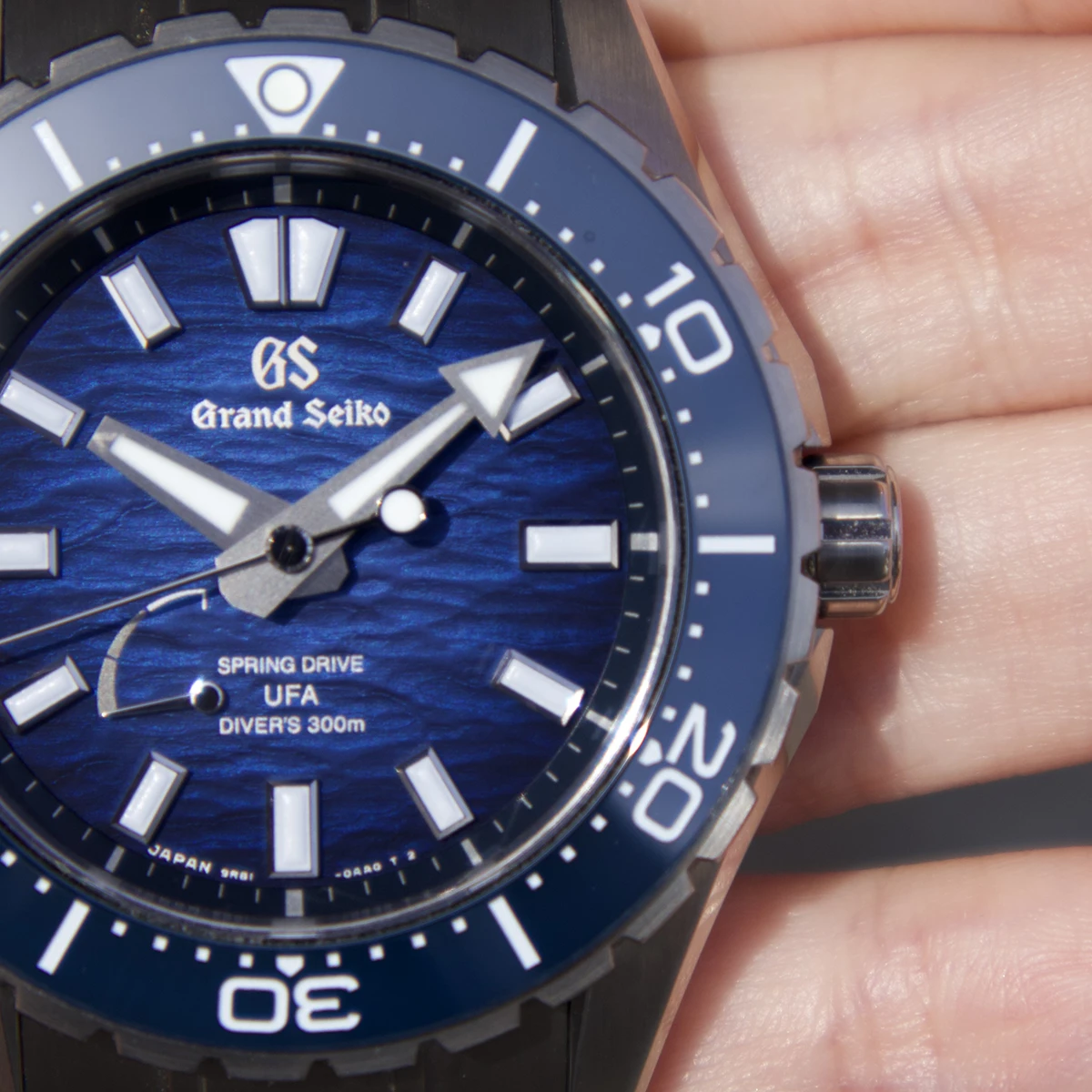
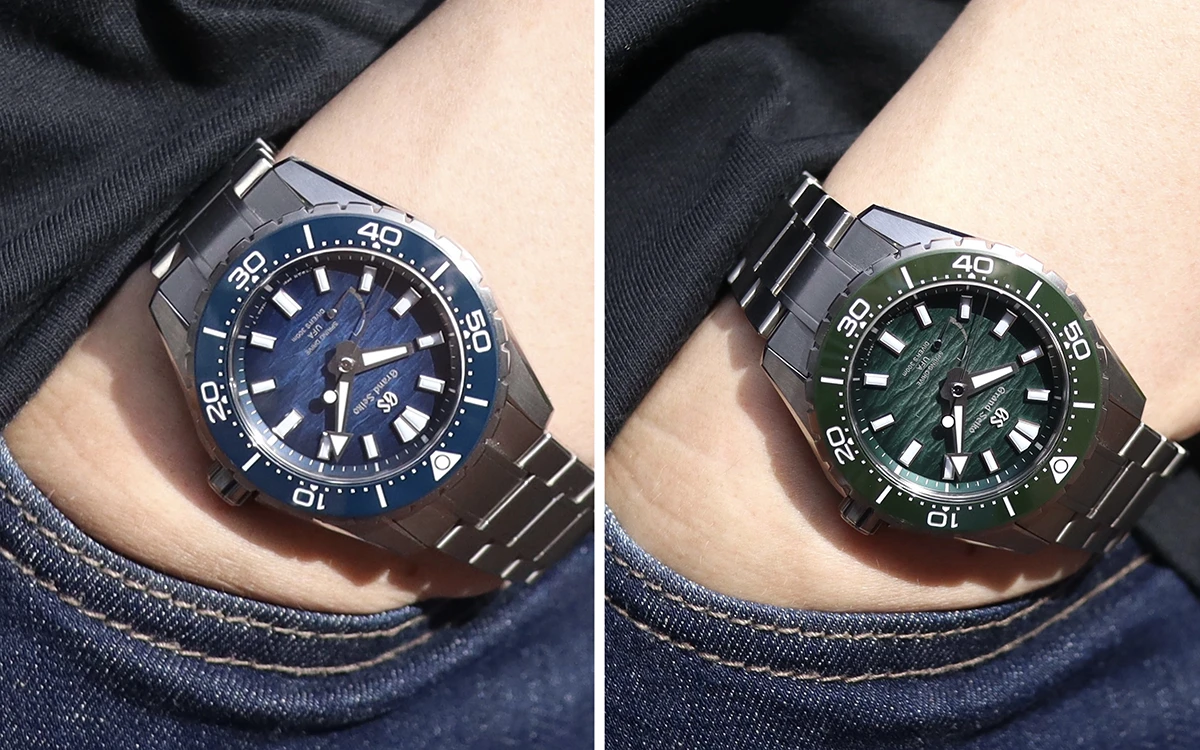
SLGB023, the dial commonly known as “Ushio Blue” expresses the process of gradually losing light as you dive deep into the vast ocean, gradually changing into a deeper color. By using a gradient that deepens from the center outward, the molding in the center is easier to see.
When it comes to blue, this is the color! It’s a blue that’s not too flashy or dull, like a low-saturation version of blue that many might think of. But it’s not just blue.
Illuminance (a unit of brightness). Indicates the amount of light per unit area) and the appearance of the mold differs, allowing you to see different expressions depending on the time, much like the sea (see image below).
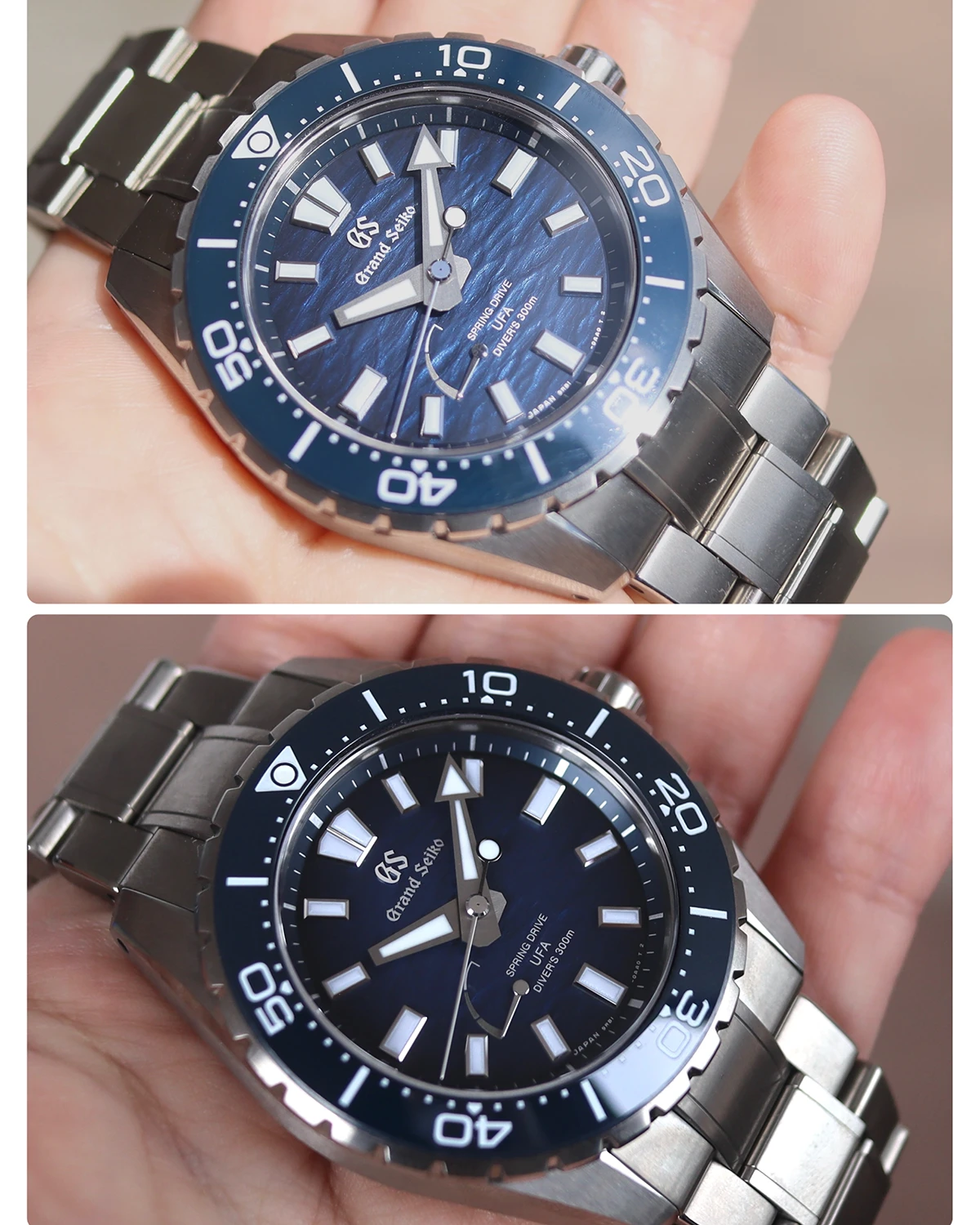
(Top) Photographed under strong sunlight. (Below) Photographed in the shade.
SLGB023 can be described as a model with significant dial color changes under strong sunlight and shade. Under sunlight, the vividness stands out, and in the shade, the molded patterns tend to subside. It feels as if it projects a calm, deep sea. The color of the ceramic bezel changes just like the dial, but under sunlight, you can sense a faint yellow tint in the bezel’s color.
Now, regarding the blue of the sea represented by this dial, have you ever wondered why the sea appears blue in the first place? I’ll explain that later.
Explanation of SLGB025 dial colors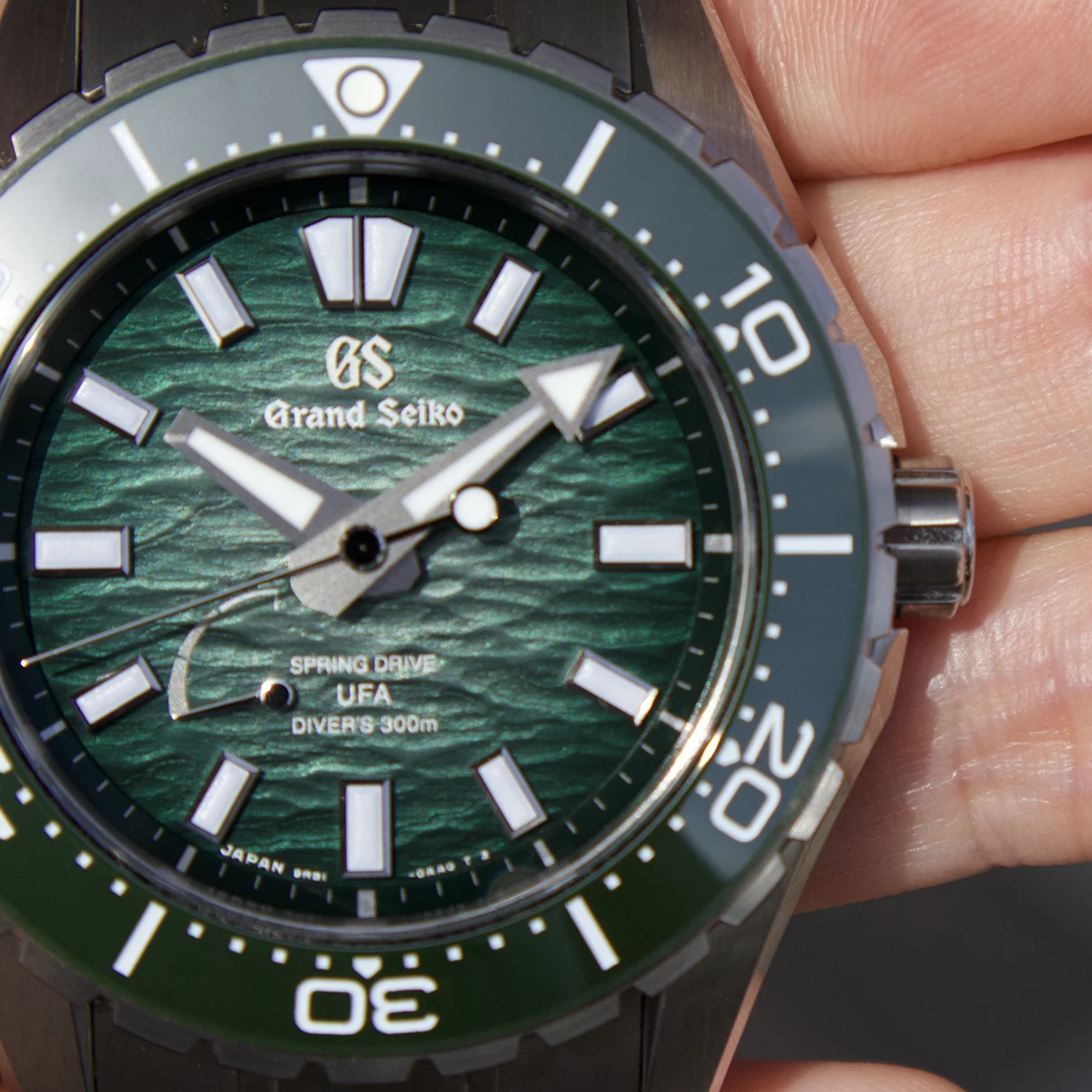
SLGB025, the dial commonly known as “Ushio Green” expresses the swaying surface of the water surface reflected by sunlight in shallow waters even in the same sea. Like SLGB023, this also features a design that increases depth from the center outward, but since a gradient paint is added to the outer edge, the central molding is easier to see, and the color range is larger than SLGB023.
Both the dial and bezel appear a calm green with a yellow tint, but under sunlight, only the dial color has a softer yellow tone and appears more vivid. Therefore, color changes due to illuminance are greater than SLGB023 (see image below).
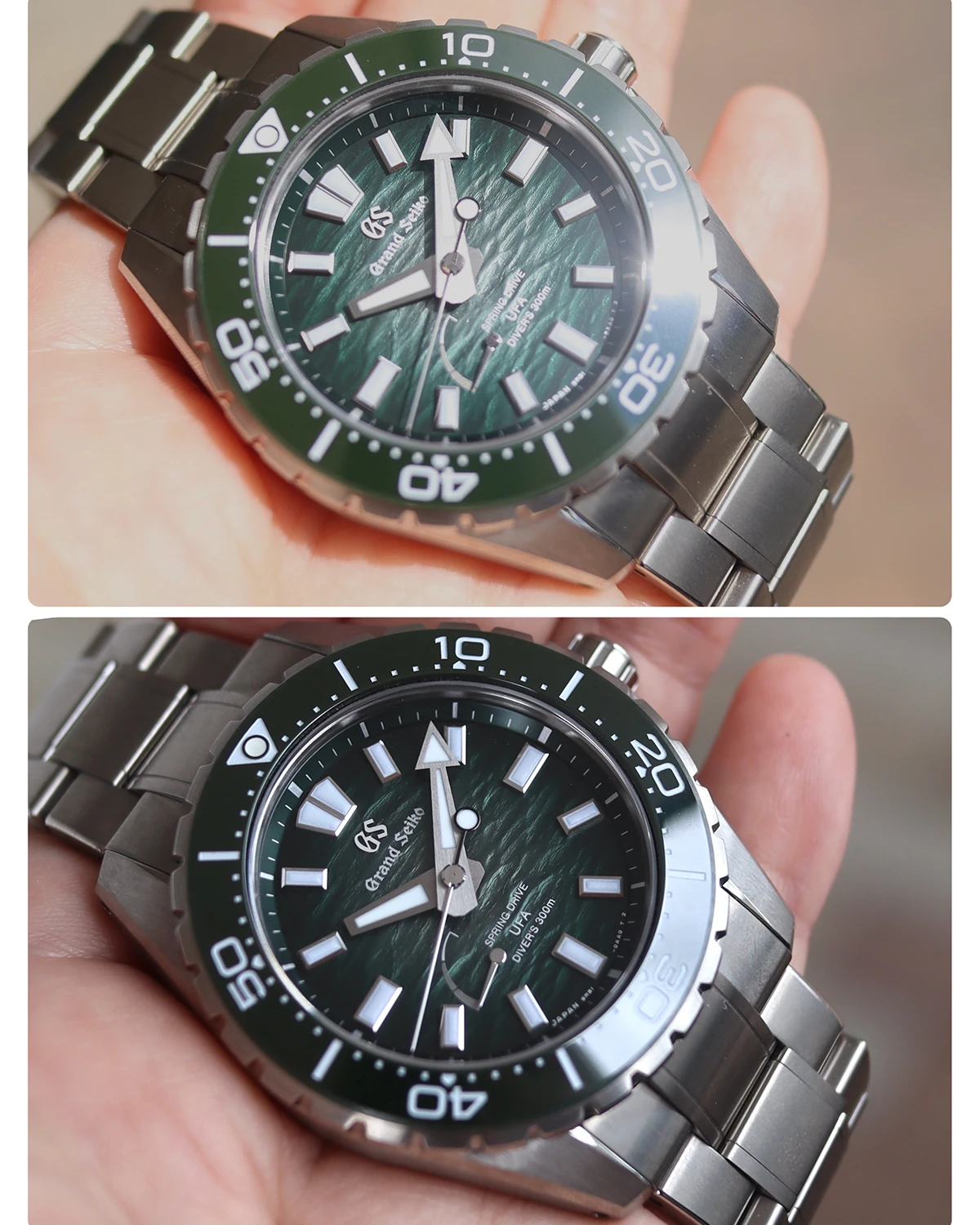
(Top) Photographed under strong sunlight. (Below) Photographed in the shade.
SLGB025 is a model with significant dial color changes under strong sunlight and shade. Especially under strong sunlight, the gradient becomes more pronounced, and a fine, pearl-like shine appears in the center. The magnitude of this color change is not only due to the intensity of the gradient but also to the optical multilayer coating. What is this optical multilayer coating? Also, why was green used to represent the shallow water surface? I’ll explain this in the next chapter.
Even with the same theme, there can be such differences!? The expression of the sea projected by two models
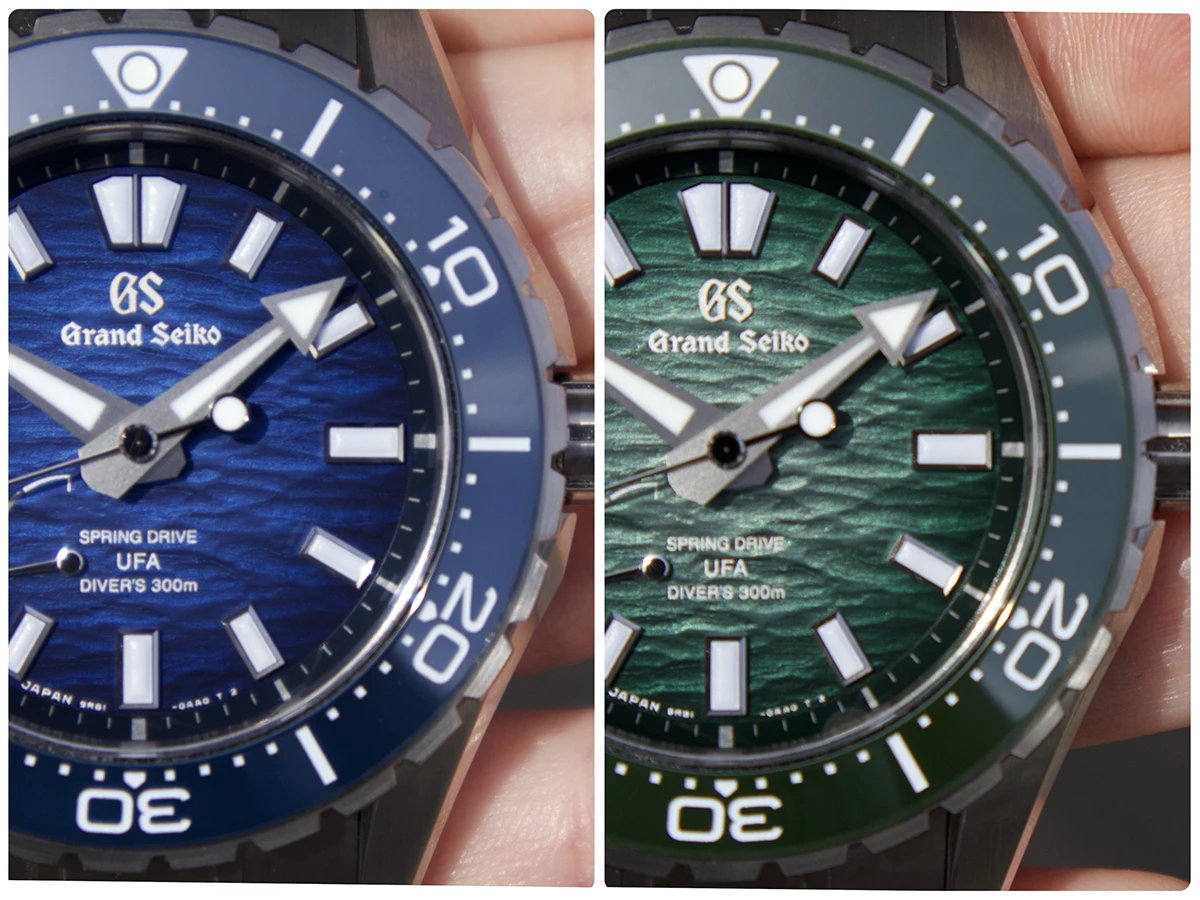
To repeat the explanation, both models are themed around the “sea.” Of course, there are many things to say ‘sea,’ but with a few exceptions, the idea is that the ocean is considered ‘blue.’ However, when you scoop up seawater with a bucket, it is not blue. Why is that?
First of all, the premise is that in the world humans see, there is no object called ‘color.’ What exists is light, and the range within which humans can perceive is called ‘visible light.’ Visible light has an iridescent gradient: ‘red, orange, yellow, green, blue, indigo, blue-violet,’ and even light that appears white at first glance is mixed with all these colors.
When this light hits an object, only the reflected colored light is captured by the lens called the eye and converted into nerve signals. Only when the brain perceives that signal can you perceive ‘blue’ = recognize the color.
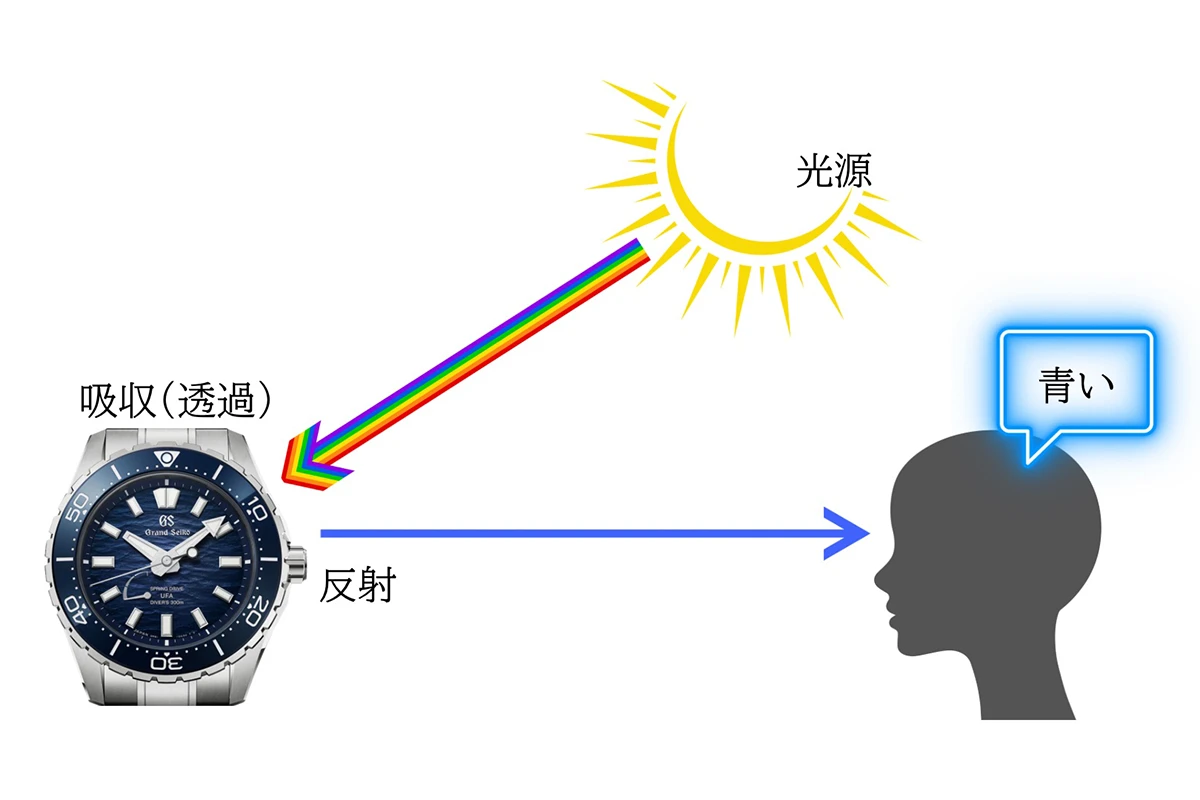
Now, let’s get back to the main topic and delve deeper into the ocean expressions projected by “Ushio Blue” and “Ushio Green,” along with how colors are visible.
Ushio Blue expresses the blue of the sea. Why is the sea blue in the first place?
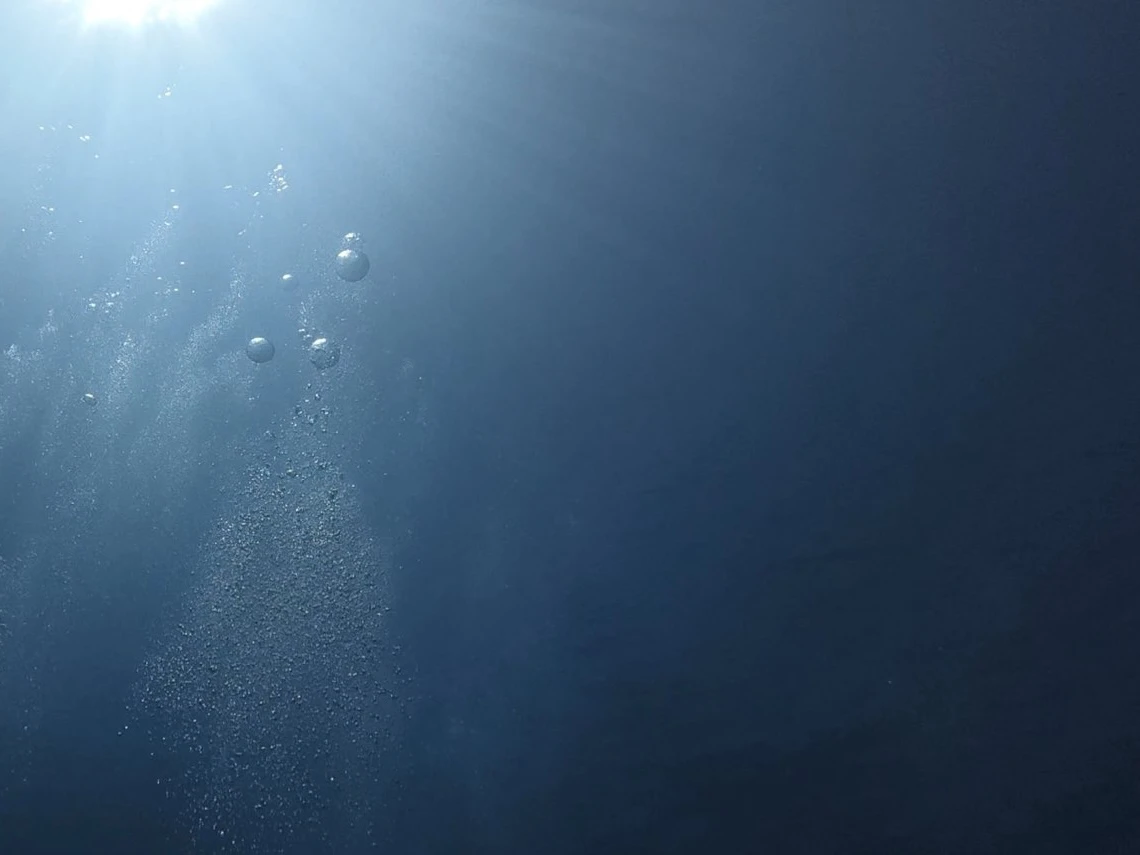
Photograph by Marume X Account @nasu_enjoy
As explained above, people recognize colors by the light that enters their eyes. So, what about underwater? Water molecules in the ocean absorb long-wavelength light (red, orange, yellow),It has a watery nature. Therefore, when sunlight hits the sea, this light is absorbed.
On the other hand, the short-wavelength “blue light” is not absorbed and penetrates into the sea, scattering in all directions, allowing the blue light to reach the human eye and making it perceive as “blue.” As the water depth deepens, the remaining blue light gradually gets absorbed or scattered as the distance lengthens, resulting in a “dark and deep blue” appearance.
Ushio Green expresses the green of the water surface. The Mystery of Changing Color When the Water Level Changes

Photograph by Marume X Account @nasu_enjoy
On the other hand, what about the shallow waters? In shallow water, light can reach the seabed before being absorbed by water molecules. If the seabed is whitish sandy, the white sand tries to reflect all the light. During this round trip, water molecules absorb light with long wavelengths of red to orange, leaving blue and green light that appears greenish-blue to the human eye.
Incidentally, the slightly murky greenish seas seen in the waters near Japan are said to be caused by phytoplankton, which absorb red and blue light to perform photosynthesis and reflect green light. Phytoplankton leave ‘green’ and water molecules retain ‘blue,’ resulting in a greenish sea. The natural world is truly fascinating.
Learn from nature. What is Optical Multilayer Coating?
Optical multilayer coating is a technique that, unlike traditional painting methods, uses PVD (*1) to create multiple nearly transparent thin films on the surface of an object, utilizing the properties of light to produce “color.” It is possible to artificially create structural colors that appear at different angles, such as bird or butterfly wings or fish scales. Let’s use a bird as an example.

Photograph by Kouki Doi
On the surface of bird feathers, there is a nanometer-scale layer made by a protein called keratin; when light hits this layer, some of it is reflected on the surface, while the rest is reflected in the inner layers. When this reflected light causes interference (*2), structural colors appear depending on the viewing angle. Optical multilayer coating allows the viewing angle to be freely adjusted depending on the design.
*1 PVD: Abbreviation for Physical Vapor Deposition. Ionizing metal with a high-temperature vacuum device and then vapor-depositing it.
*2 Interference: When two or more light sources passing through multiple paths overlap, light of a specific wavelength strengthens each other, while light of other wavelengths cancels out. This phenomenon also occurs on the surface of pearls and soap bubbles.
This technology forms a thin film that traces the dial’s uneven patterns, enabling rich color expression while preserving the beautiful texture. Dial colors expressed through optical technology. Next, let’s introduce coordination ideas to enhance the dial color and enjoy fashion.
The ultimate watch coordination icon!? Putting ‘picking up colors’ into practice!
For this coordination, I tried using the classic method of “picking up dial colors,” which is a key element when coordinating watches. For SLGB023, you pick “blue” and for SLGB025, “green,” but rather than simply combining the same colors, let’s introduce two different outfit patterns that vary the brightness and saturation of the colors.
Recommended SLGB023 Coordination
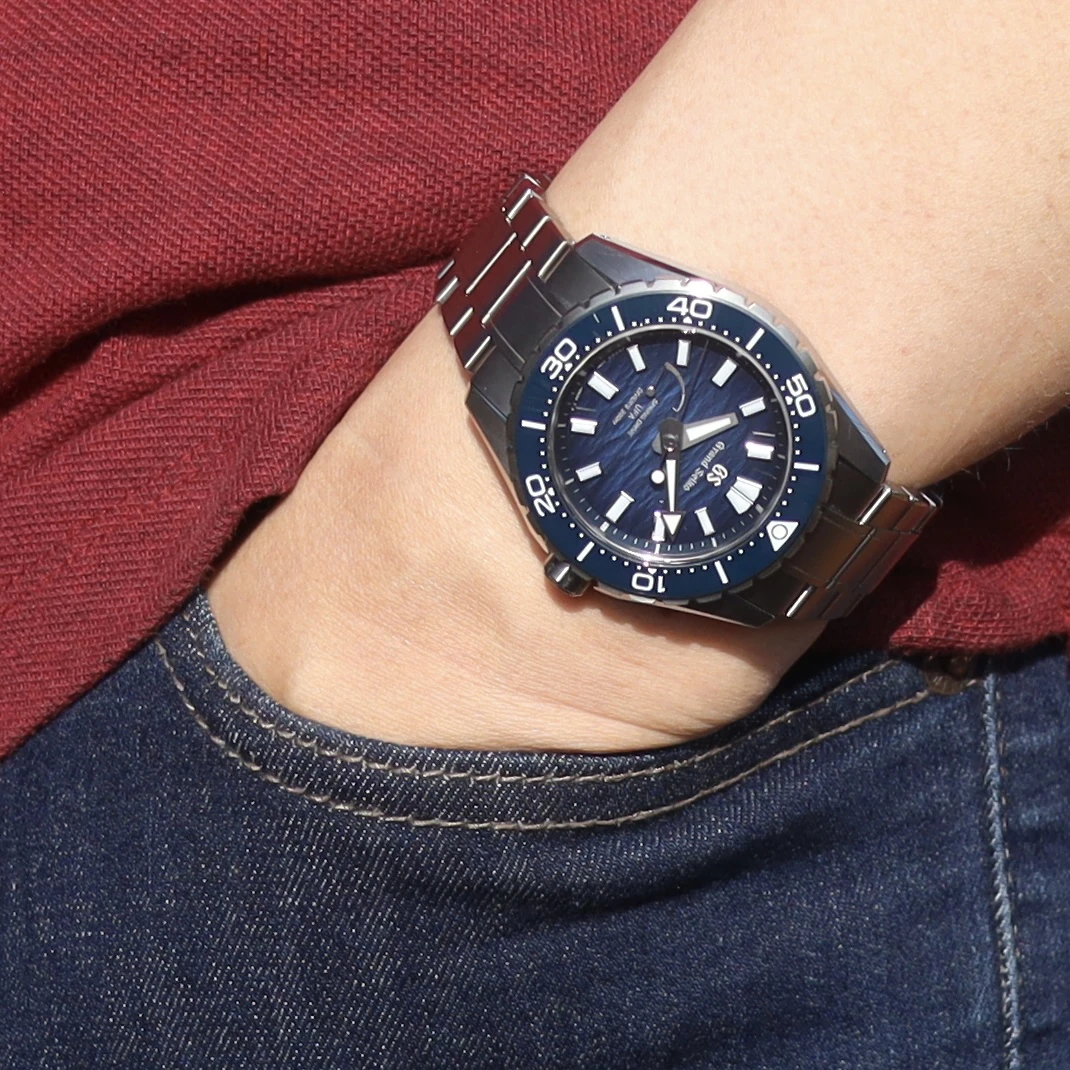
The model’s wrist circumference is 17cm.
A contrasting color scheme combining blue pants with slightly lower dial brightness and saturation and a red top that isn’t too vivid. Although the hue (hue) is quite different, both colors have reduced saturation, resulting in a unified and calm overall impression. Conversely, if you want to add a lively vibe, increase the saturation of red.
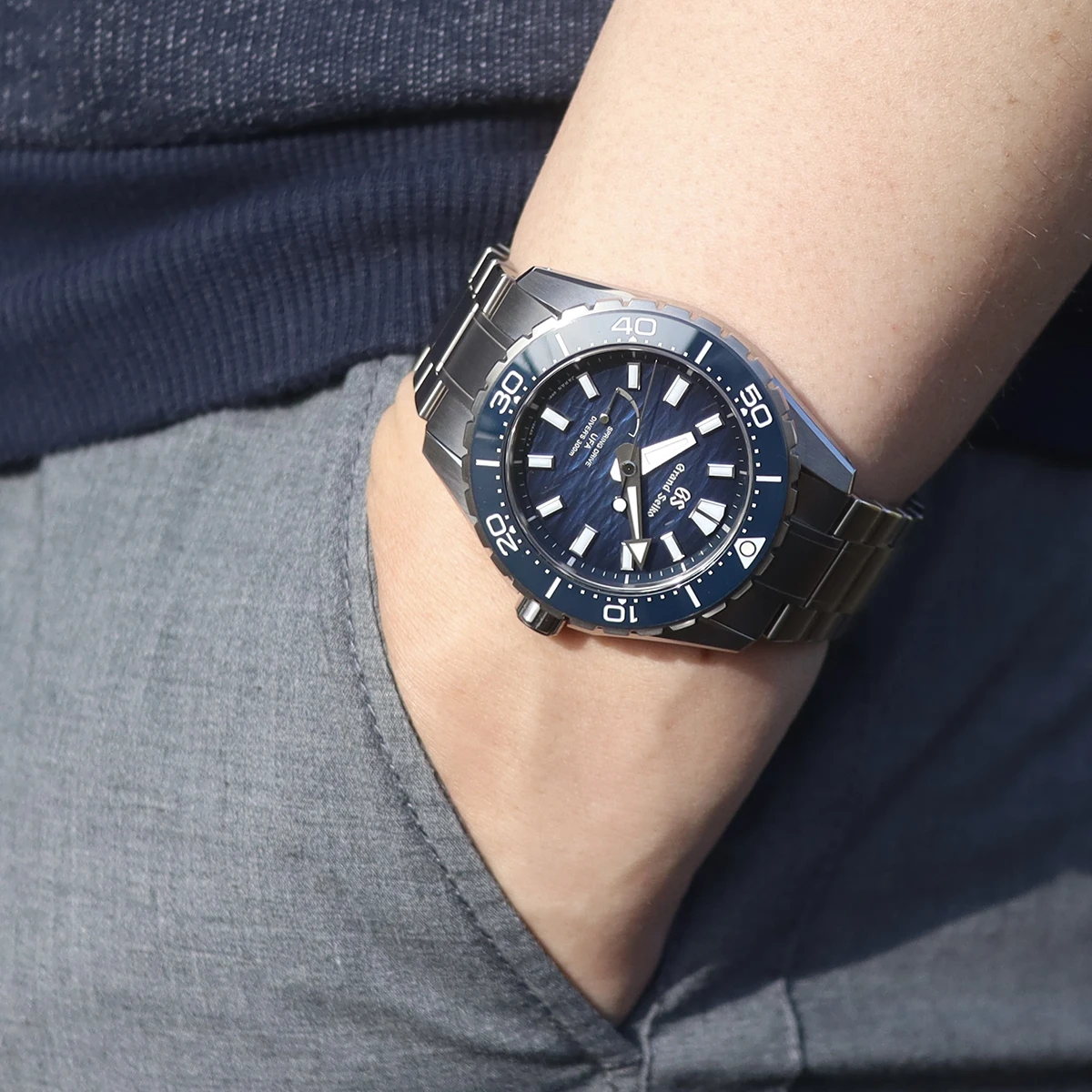
This outfit also features a blue top in the same color as above, paired with bright gray pants. Both the top and pants are colored by the watch (dial color → top, band color → pants). By matching the large area of clothing with the watch, the whole outfit gains a sense of unity.
Recommended SLGB025 Coordination
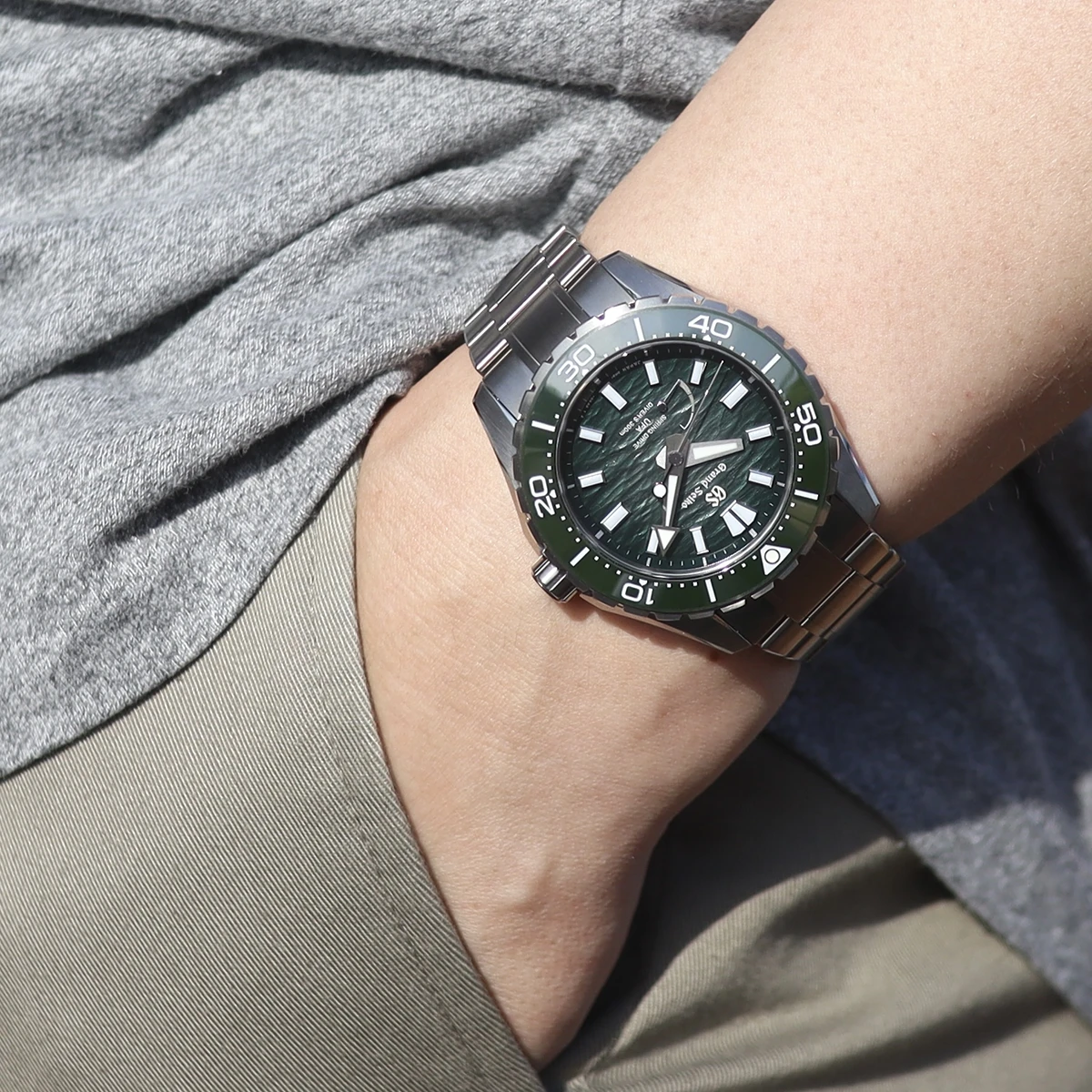
A look that combines khaki beige pants with a dial color (especially bezel color) that seems to have increased brightness, paired with a gray top. Both the top and pants are colored by the watch (dial color → top, band color → pants). By increasing the brightness of the pants color, you can make the watch stand out a bit, giving it a sophisticated, mature impression.
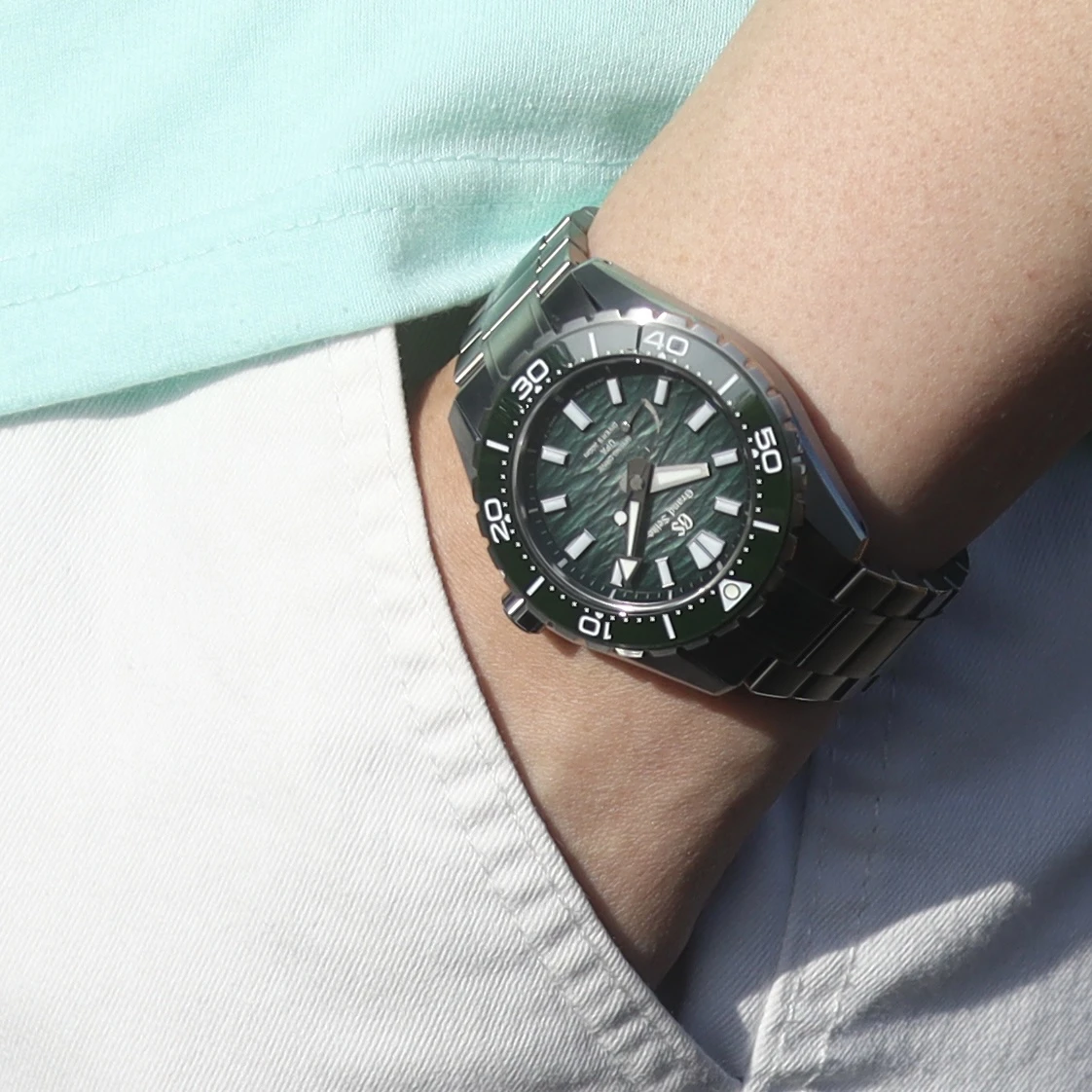
At first glance, it might seem like it doesn’t pick up any color. Although there is a slight shift in hue (hue), mint green = a color with increased brightness and saturation of the dial color, while white is a color where the gray brightness of the band is maximized.
In other words, both the top and pants are coordinated to match the color of the watch. It’s the same method as the ‘gray × khaki beige’ mentioned above, but the impression might be completely opposite. I just want a fresh impression! I highly recommend this place.
Carrying the ocean scenery on your arm. “Blue or Green”—Which do you choose?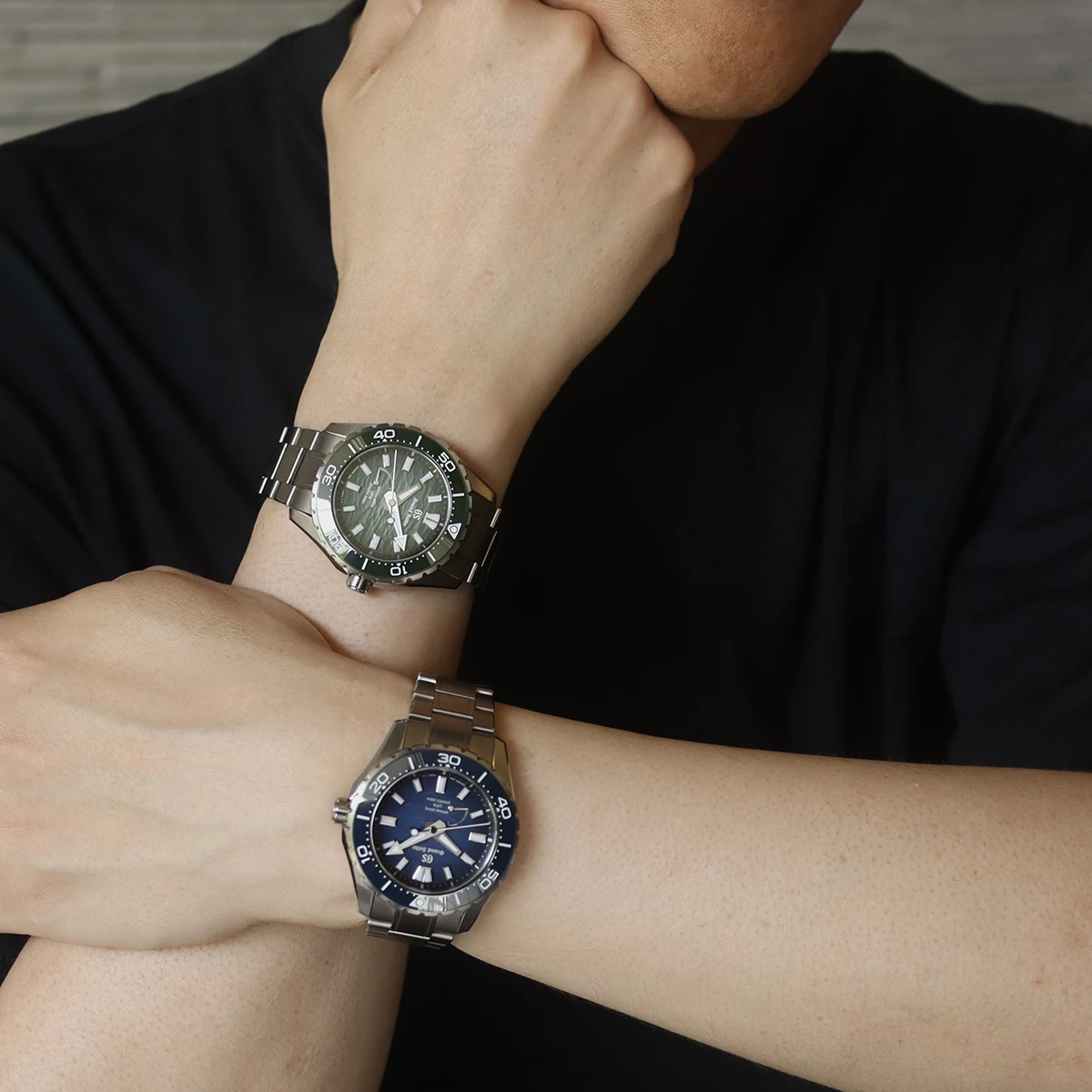
SLGB023, did you convey the appeal of the 025 model? This time, I touched a bit on the inside and exterior of the watch, but my former watch salesperson’s spirit was ignited, and I wanted to write more! There were so many different charms that you might think so.
When it comes to divers, readability and legibility are prioritized, so you might not feel the need for elaborate dials. However, this time I felt Seiko’s pride in that. This model was likely born precisely because Grand Seiko, whose brand philosophy is “THE NATURE OF TIME,” was born.
Summer is about to begin. If you were to put this work, which projects the scenes of two seas, on your wrist, would you choose “Blue or Green”?
Author Profile
Mutsuyo Ito
He provides a wide range of consulting services related to the ‘products, places, and people’ in sales, including color supervision and image consulting for watch manufacturers, personal color diagnoses at event venues, and customer service instructors. Holds numerous qualifications, including Level 2 Watch Repair Technician, J-color Certified Instructor, and GIA AJP. He is the CEO of parakeITO Inc. HP:https://www.mutsuyo-ito-parakeito.com/
Contact info: Seiko Watch Co., Ltd. Customer Service (Grand Seiko) Tel. 0120-302-617